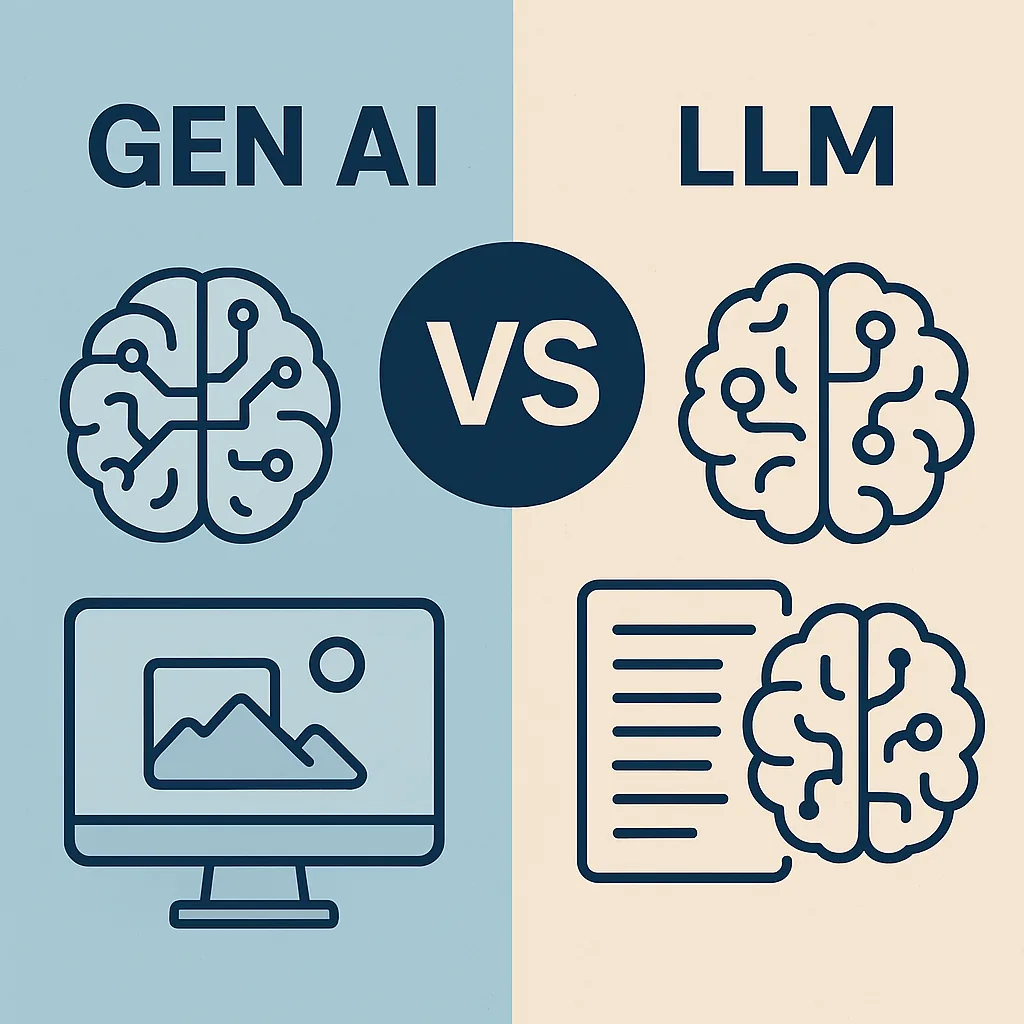
Generative AI and Large Language Models (LLMs) are closely related concepts in artificial intelligence, but they differ in scope, function, and application. This article explores their differences, similarities, and practical use cases.
Core Concepts
Generative AI refers to AI systems capable of creating new content based on learned patterns from existing data. This content can be text, images, audio, video, or code. Its main goal is to generate outputs that are coherent, creative, and contextually appropriate. Examples include AI image generators, music composition AI, and text generation systems.
Large Language Models (LLMs) are a subset of generative AI specifically designed to process and generate human-like text. They are trained on massive text datasets and can perform tasks such as summarization, translation, question answering, and code generation. GPT, LLaMA, and PaLM are examples of LLMs.
Differences Between Generative AI and LLMs
| Aspect | Generative AI | Large Language Models |
|-----------------|--------------------------------------------------|--------------------------------|
| Scope | Can generate text, images, audio, video, code | Primarily focused on text |
| Training Data | Multi-modal: images, audio, text, structured | Text-based datasets, code |
| Applications | Image synthesis, video generation, AI art, music | Chatbots, content generation, code assistance |
| Examples | DALL·E, MidJourney, MusicLM | GPT-4, Claude, LLaMA, PaLM |
| Complexity | Can involve multiple neural network architectures | Typically transformer-based |
Overlaps
• Text Generation: LLMs are a type of generative AI for text, so every LLM is generative AI, but not all generative AI are LLMs.
• Creativity and Pattern Recognition: Both leverage learned patterns to produce new content.
• AI Applications: Both can be integrated into tools for content creation, automation, and decision support.
Practical Examples
Generative AI Examples
• DALL·E: Generates images from text prompts.
• MusicLM: Produces music from descriptive text input.
• Runway: Generates video and visual effects using AI.
LLM Examples
• ChatGPT: Conversational AI for answering questions and writing content.
• GitHub Copilot: Assists developers by generating code snippets.
• Claude: Enterprise-focused language model for summarization and decision support.
Use Case Comparison
| Use Case | Generative AI | LLM |
|------------------------|---------------|------|
| Creative Art | High | Limited |
| Content Writing | Medium | High |
| Code Assistance | Low | High |
| Multi-modal Media Gen | High | Low |
| Data Summarization | Medium | High |
Key Takeaways
• Generative AI is a broad concept encompassing all AI that generates content, including text, images, audio, and video.
• LLMs are specialized generative AI models focused on natural language understanding and generation.
• LLMs excel at text-based tasks but do not natively handle other modalities like images or music without integration.
• Both technologies are complementary and often combined in multi-modal AI platforms to extend capabilities.
This distinction is important for organizations planning AI adoption, as the choice between a general generative AI system or a specialized LLM depends on the type of content they need to generate and the context of its application.